


Enhanced clinical pathways
Smarter clinical pathways for heart disease treatment, making healthcare more efficient and user-centered, which will lead to improved patient outcomes.

Patient-Centered care
Patients will benefit from personalized healthcare approaches, leading to better detection, diagnosis, and management of heart disease across the care pathway.

Support for healthcare professionals
Healthcare workers will gain access to novel diagnostic procedures and optimized workflows, enhancing clinical outcomes and improving overall healthcare delivery.

Research and innovation
GRACE will contribute to the academic and industry research on heart disease treatment, developing new personalized methodologies validated across multiple countries.

Cost-effectiveness
The project will analyze and report on the cost-effectiveness of its interventions compared to traditional treatments, ultimately reducing operational costs in healthcare.
Build. Pilot. Prove.
Work plan
and governance
At the core of the project there is a set of work packages categorised in clinical, methodological and piloting work. The clinical work is performed in WP3 and WP4, improving the processes and early interventions in healthcare systems and providing strategies, guidelines and models to WP5.
The methodological work performed in WP5 designs the tools to provide the continuum of care, offering the common blueprints for the execution of pilots as well as some common technologies. WP6 coordinates pilot execution, from set-up to monitoring, throughout the different use cases, where the models and tools play the central role. WP7 uses these pilots to evaluate how the models and tools actually impact clinical outcomes.
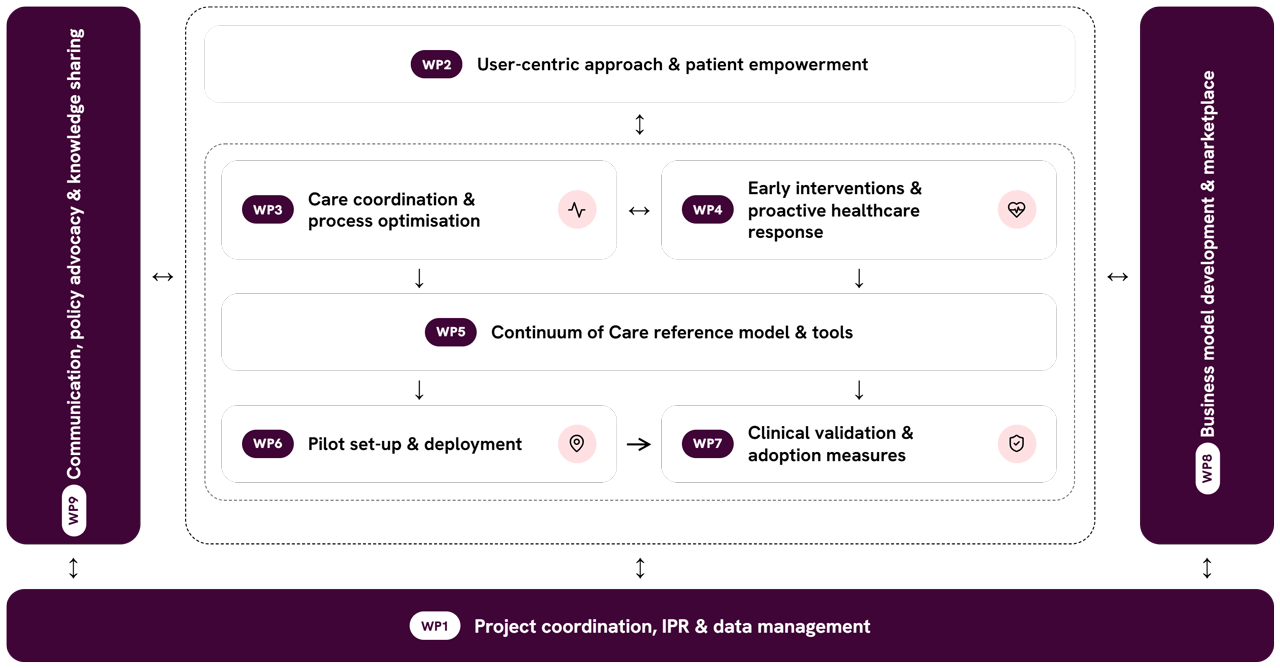
Providing a cohesive design framework to the core work packages, WP2 promotes co-design strategies by organising structured workshops, focus groups and living lab sessions to iteratively validate requirements and designs. Stakeholder involvement includes patients and caregivers, providing insights into user needs and references; healthcare professionals, contributing clinical expertise for solution feasibility; policymakers and regulators, ensuring alignment with healthcare policies and standards; and technology developers, refining technical aspects based on usability feedback. These activities are scheduled across all project phases (M1–M54), with specific milestones for gathering feedback during early design (Phase 1), prototype development (Phase 2) and pilot testing (Phase 3)
Around all these activities, WP8 and WP9 help make the project a reality: developing the sustainability strategies that launch the concept beyond the project timespan, and developing and executing an outreach plan through communication with the public, creating key communities and engaging policymakers. WP1 aggregates the coordination activities, ensuring a smooth project execution.